


 EN
EN DE
DEFOG Ransomware: What You Need to Know & How to Recover Fast
FOG Ransomware is one of the most aggressive ransomware variants, targeting businesses of all sizes with rapid encryption and extortion tactics. Learn how it works, see real attack examples, and—if your systems are compromised—let our experts help you restore encrypted data and get back to business.
How to identify if FOG ransomware infected your system
If you’re unable to open your files, notice an unusual file extension, or find a message demanding payment to regain access, FOG ransomware might be the cause.
Initially identified in May 2024, FOG ransomware has been targeting organizations with steep ransom demands.
Files encrypted by FOG typically have their extensions changed to .fog or .flocked.

Disable security software
Your antivirus software is not working or is deactivated.
Double Extortion Tactics
Steals sensitive data before encrypting files, threatening public leaks.
Rapid Encryption
One of the fastest ransomware encryption speeds, making attacks harder to stop.
Encryption of Network Shares
Encrypts files across shared drives and servers to maximize operational disruption.Why You Shouldn’t Attempt to Fix It Alone
If FOG ransomware has hit your business, taking the wrong steps can cause permanent data
loss or legal risks. Like a crime scene, a ransomware attack must be preserved—tampering
with encrypted files, attempting self-recovery, or engaging with attackers can destroy
critical evidence and reduce your chances of recovery.
The right response in the first moments after a FOG attack can make the difference
between full recovery and permanent data loss. Follow these critical steps to protect your
data and maximize your chances of restoring operations.

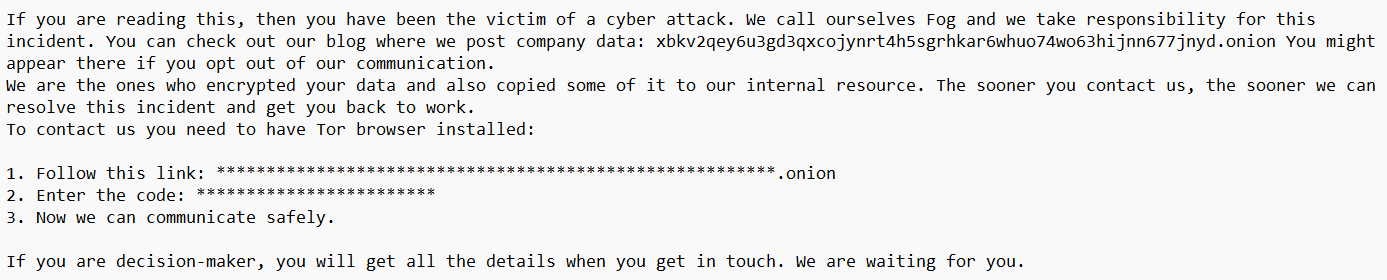
If you find a “ReadMe” note on your system showing information like the above, you’ve likely suffered a FOG Ransomware attack.
Do not modify, restore, or overwrite data.

What to do if your data is encrypted by FOG
If you’ve fallen victim to ransomware, follow these crucial steps:
Request 24/7 Ransomware Recovery Help
Get expert guidance to assess, contain, and recover safely.
Isolate Infected Systems
Disconnect infected devices to stop the spread. Avoid self-recovery.
Preserve Evidence Immediately
Keep ransom notes & logs. Do not restart or modify anything.
FOG ransomware statistics & facts
RANSOM AMOUNTS
FOG ransomware often targets medium to large companies or organizations using complex attacks.
The FOG ransom demands range from $50,000 into the millions of dollars. Ransoms are usually paid in Bitcoin. Quick-buy methods of purchasing Bitcoin with PayPal or credit cards do not work for this size of ransom payment and it is important to obtain expert advise to ensure that a payment of this size is legally compliant.
AVERAGE LENGTH
FOG ransomware attacks are intricate and can lead to prolonged downtime, often due to large ransom demands and the complexities of secure payment processing.
For most ransomware victims, downtime is the most costly aspect of the incident, with potential for considerable reputational harm.
Our extensive experience with FOG ransomware gives us a deep understanding of the gang’s tactics, enabling us to resolve attacks swiftly and restore your files.
CASE OUTCOMES
Several gangs operate FOG ransomware. While most reliably deliver functioning decryptors upon payment, it’s crucial to confirm you’re dealing with a reputable group, as some ransomware gangs have been known to take payments without providing decryption keys.
COMMON ATTACK VECTORS
The most common method used by FOG ransomware to infect victims is phishing.

How to identify FOG ransomware
This is an average FOG ransomware note. (With slight redaction in the interest of public safety)
FOG decryptor demonstration
This is a technical demo of the FOG Decryptor. Copyright by BeforeCryptExperiencing Ransomware or Cyber Breach?
Get Help NowFrequently asked questions
Decryption depends on the ransomware variant. In some cases, publicly available decryption tools exist, but not all attacks have a known solution. You can submit a free ransomware recovery request, and we will check for possible decryption methods.