

 EN
 DE
Everest Ransomware: What You Need to Know & How to Recover Fast
Everest has hit healthcare providers, manufacturers and aviation-sector suppliers worldwide through stolen remote-access and file-sharing credentials, stealing data and often skipping encryption entirely in favour of leak-site extortion. See how its insider-recruitment scheme and short leak-site countdowns pressure victims, and — if your systems are compromised — how BeforeCrypt’s team contains the breach and restores operations.
What is Everest Ransomware?
Everest has run as a Russian-speaking extortion operation since December 2020, claiming victims across healthcare, manufacturing, government and aviation in dozens of countries, with ransom demands reaching eight-figure sums in high-profile cases. Its Windows-only C#/.NET encryptor appends the .everest extension, though since around 2025 the group has often skipped encryption entirely in favour of data-theft-only extortion. BeforeCrypt has worked on Everest engagements and can help you contain the attack, assess what was taken, and restore operations safely.

Dual Extortion Model
Everest frequently skips encryption and extorts victims solely over stolen data.
Credential-Based Intrusions
Access is typically gained via compromised VPN, RDP or file-sharing platform credentials; phishing and exploitation of public-facing applications are also reported.
Initial Access Brokerage
The group also sells stolen network access to other threat actors as a separate revenue stream.
Short Leak-Site Deadlines
Leak-site postings often carry short countdown deadlines before threatened data publication.Why You Shouldn’t Attempt to Fix It Alone
Everest’s encryptor wraps its key with a per-build RSA public key, and researchers found no demonstrated way to recover files without the attacker’s private key. BeforeCrypt checks for available decryption tools, including free ones, as part of every assessment, and tests any candidate on copies first — an unverified tool can make recovery harder, not easier.
Everest typically steals data before encrypting, and since around 2025 has often skipped encryption entirely in favour of leak-site extortion. Even if backups restore your files, stolen data can still be published or sold — an additional risk for your business, separate from file loss. Notification obligations depend on your sector and geography — see the FAQ below for the regulatory clocks that may apply.
Where your team lacks capacity, BeforeCrypt runs full incident response — triage, containment and recovery — or supports your existing IT staff. We verify what data was taken, screen for sanctions exposure, and preserve evidence for insurers and regulators. Negotiation, including reducing the demand, is one option we can handle when it’s the right route. Handling response, coordination and attacker contact together strains any internal team.
An experienced internal security team can handle substantial parts of the response itself. Our detailed emergency response plan walks through the sequence step by step. A free assessment call with our team helps you decide quickly which parts to keep in-house and where specialist support saves time.
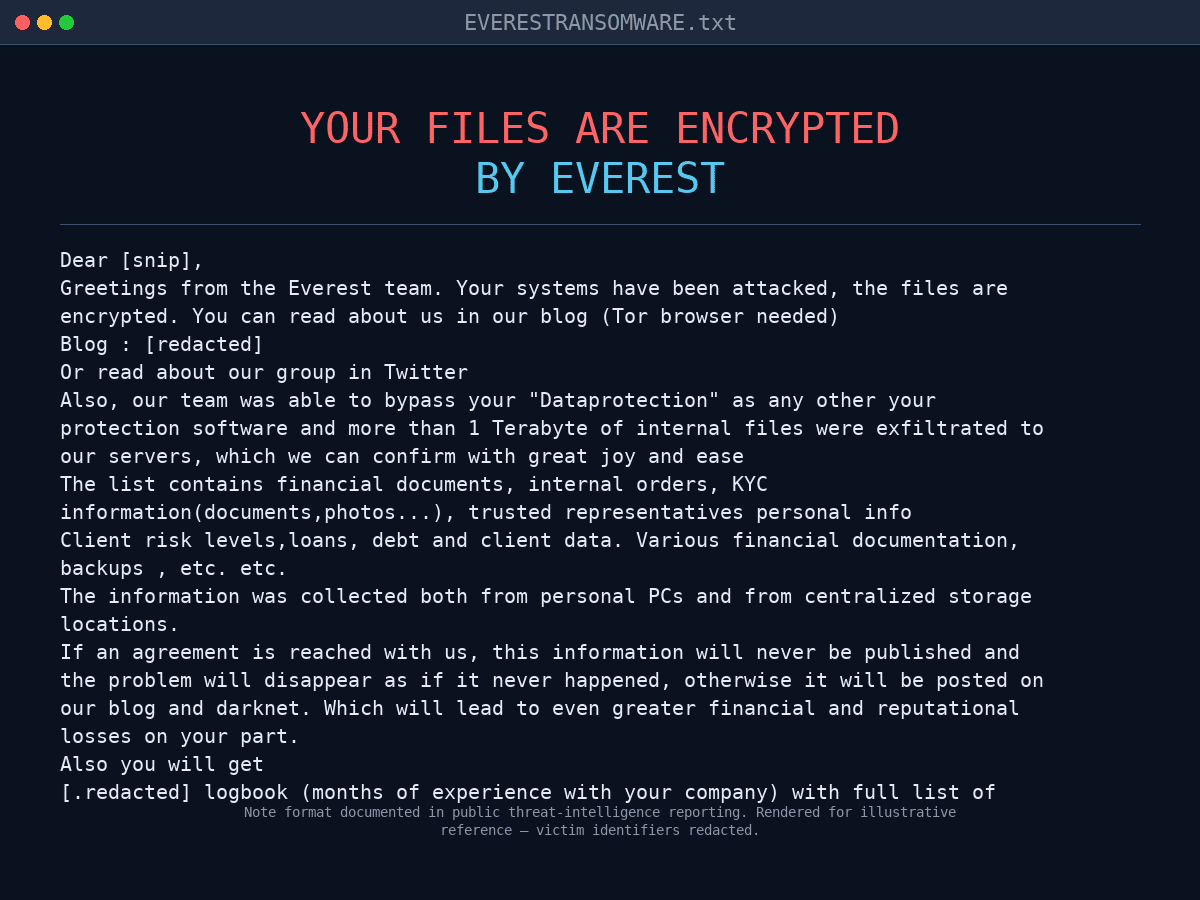
Everest’s ransom note, typically named EVERESTRANSOMWARE.txt, is dropped into every affected folder and on the desktop, opening with a reference to the ‘Everest team’ and a line naming the target organisation. It lists a contact email and the group’s Tor-based leak-site address, while older ‘EVEREST LOCKER’ notes also listed an XMPP/Jabber fallback address and offered free test decryption as proof.
YOU MUST NOT ATTEMPT TO TOUCH, RESTORE OR OVERWRITE THE DATA.

Hit by Everest Ransomware? Take These Immediate Recovery Steps
If you’ve fallen victim to ransomware, follow these crucial steps:
Request 24/7 Ransomware Recovery Help
Get expert guidance to assess, contain, and recover safely.
Isolate Infected Systems
Disconnect infected devices to stop the spread. Avoid self-recovery.
Preserve Evidence Immediately
Keep ransom notes & logs. Do not restart or modify anything.
Everest ransomware statistics & facts
RANSOM SUMMARY
| Name | Everest (linked to EverBe 2.0 and BlackByte code lineage) |
| Danger level | High. Combines data theft, selective encryption and insider recruitment to pressure victims. |
| Release date | First observed December 2020 |
| OS affected | Windows (C#/.NET encryptor; sample analysed in 2026: .NET Framework 4.0, ~114 KB, protected with ConfuserEx) |
| Appended file extensions | .everest |
| Ransom note filename | EVERESTRANSOMWARE.txt (historically EVEREST LOCKER.txt) |
| Contact channels | Email address embedded in the note, Tor-based leak site/blog; older samples also used XMPP/Jabber |
COMMON ATTACK VECTORS
- Valid Accounts (T1078) — compromised or purchased credentials, including logins for third-party file-sharing and data-exchange platforms
- External Remote Services (T1133) — RDP, VPN, AnyDesk, Splashtop and Atera used for access and lateral movement
- Exploit Public-Facing Application (T1190) — vulnerable or misconfigured internet-facing systems, including an FTP server with stale static credentials in one documented case
- Phishing (T1566) — reported as an initial-access route alongside credential theft
RANSOM AMOUNTS
Everest has targeted healthcare providers, manufacturers and aviation/transport suppliers across North America, Europe and Asia, frequently entering through stolen credentials for remote-access or file-sharing platforms.
Everest ransom demands have reached eight figures: in July 2026 the group demanded CHF 10 million (around $12.3 million) from a Swiss manufacturer, which publicly refused to pay and filed a criminal complaint. Ransoms are reportedly requested in Monero rather than Bitcoin. Quick-buy methods of purchasing cryptocurrency with PayPal or credit cards do not work for this size of payment, and it is important to obtain expert advice to ensure that a payment of this size is legally compliant.
Where negotiation is the right option, our experienced negotiation team has consistently secured meaningful reductions from the initial demand to the final settlement across Everest engagements.
AVERAGE LENGTH
Before encrypting, Everest deletes shadow copies and backups, disables Windows Defender’s Controlled Folder Access, re-enables SMBv1 and wakes sleeping hosts over the network to pull them into the attack — all of which extends both containment and restoration work.
For most ransomware victims, downtime is the most costly aspect of the incident, with potential for considerable reputational harm.
Our extensive experience with Everest ransomware gives us a deep understanding of the gang’s tactics, enabling us to resolve attacks swiftly and restore your files.

How to identify everest ransomware
Everest drops a note named EVERESTRANSOMWARE.txt into every encrypted folder and on the desktop, opening with a reference to the ‘Everest team’ and a line naming the target organisation. It lists a contact email and the group’s Tor leak-site address, and in some cases a claimed volume of stolen data.
Frequently asked questions
Decryption depends on the ransomware variant. In some cases, publicly available decryption tools exist, but not all attacks have a known solution. You can submit a free ransomware recovery request, and we will check for possible decryption methods.
In most cases involving personal data, which applies to nearly every ransomware incident, reporting is legally required. In the EU, GDPR requires notification to the relevant data protection authority within 72 hours of becoming aware of a personal data breach. The UK ICO requires the same 72-hour window. In the US, HIPAA-covered entities have 60 days to notify affected individuals (and immediately for breaches affecting 500+ people). The clock starts from awareness of the incident, not from a full technical understanding.
In most jurisdictions, paying a ransom is not illegal in itself — but it can become illegal if the payment ends up going to a sanctioned entity or country (OFAC-designated groups in the US, EU sanctions lists, UK Treasury lists). Before any payment, sanctions screening is essential. BeforeCrypt handles this compliance layer as a standard part of every engagement.
Most established ransomware groups do provide working decryption tools when paid — the business model depends on their reputation for delivery. However, decryptors are often slow, incomplete, or corrupt a percentage of files during recovery. This is where working with a specialist matters: BeforeCrypt tracks the delivery reliability of specific groups, negotiates sample-file decryption as proof of capability where the group allows it, and plans realistic recovery timelines based on our own engagement history with each group.
Most modern ransomware groups follow through on publication threats — stolen data appears on the group's leak site, is often mirrored to Telegram and dark web forums, and may be sold to third parties. Recovery becomes limited to whatever you can rebuild from backups.
Backups protect against file loss but not against data theft. Most modern ransomware groups exfiltrate sensitive data BEFORE encryption and threaten to publish it regardless of your recovery capability. This is why leak-site publication and negotiation still matter even for organisations with clean, offline backups — and why "we can just restore from backup" rarely tells the full story.
In most jurisdictions, yes — reporting is a standard part of a ransomware incident and, in some cases, legally required. In the US, that means the FBI (via IC3 or a local field office) and CISA. In the EU, national CERT and cybercrime units. Reporting does not obligate you to any specific recovery path but does open access to threat intelligence and, occasionally, decryption tools recovered by law enforcement.
Yes. We’ve handled 1,700+ incidents across ransomware, BEC and data-leak extortion. We identify the variant, decide decrypt vs. clean verified restore, and guide a controlled return to operations. When needed, we support negotiation & compliance—always legally and with a clear audit trail.
Yes. We produce insurer-ready incident reports with a defensible timeline, scope, likely entry path, exfiltration assessment, actions taken, and chain-of-custody. We can join the adjuster call, map our findings to your carrier’s forms, and provide GDPR/NIS2 notifications where required. Final acceptance always depends on the policy and carrier, but our packages are designed to speed up approvals and reduce back-and-forth.
MSPs keep IT running; they’re not built for evidence handling and incident triage. Insurer panels optimize claims, not necessarily speed & clarity for your business. We work alongside both: kick off in ≤2h, run forensic triage with chain-of-custody, coordinate safe containment, and deliver executive- and insurer-ready findings—without taking your environment hostage.
Because it turns chaos into fast, safe recovery. We cut downtime and limit damage while preserving evidence. Within ≤48h you get a forensic triage pack (timeline, likely entry path, scope, decrypt-vs-clean-restore decision, go-live criteria) so leadership can act with confidence. Result: controlled, verified restart—not guesswork.